Why Sleep Timing Outweighs Sleep Duration: 2 Recovery Phases You're Probably Missing
Core Takeaway: Getting a lot of sleep doesn't mean you will be in good shape tomorrow. If you sleep at an inappropriate time, you are likely to miss two essential recovery periods.
That's why you sleep for eight hours or more at night, but still feel tired when you wake up.
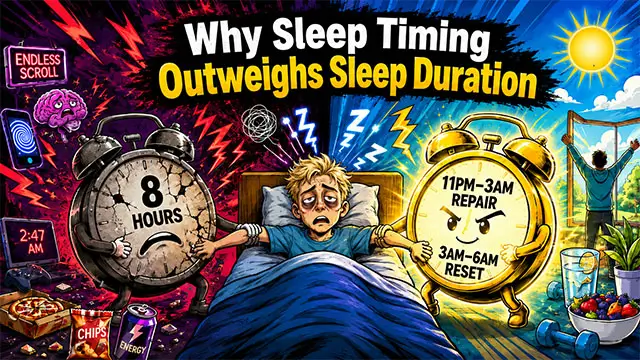
Recently, a post about tips for getting refreshed by having good sleep has received 132,000 views on X.
But what brings good sleep? Only getting 8 hours of sleep? Of course not.
Emerging sleep science tells the truth: when you sleep matters more than how long you sleep.
The 8-Hour Myth: Why Duration Alone Doesn't Guarantee Good Sleep
According to the National Sleep Foundation, adults should get 7 to 9 hours of sleep, so many people believe they can be in good shape as long as they get 8 hours.
However, it is not often the case. You might miss two far more important factors: sleep quality and circadian rhythm.
Put simply, your circadian rhythm is your body's internal 24-hour clock. It regulates everything from hormone release to metabolism to brain function. It's synchronized to light and dark, and it schedules specific repair tasks for specific times of night. When you sleep out of sync with this clock, you force your body to perform the wrong functions at the wrong time.
Think of it as a factory with a night-shift schedule. If workers show up 3 hours late, they can still put in 8 hours, but they'll miss the most critical production time, make more mistakes, and leave half the work unfinished. Your body works the same way.
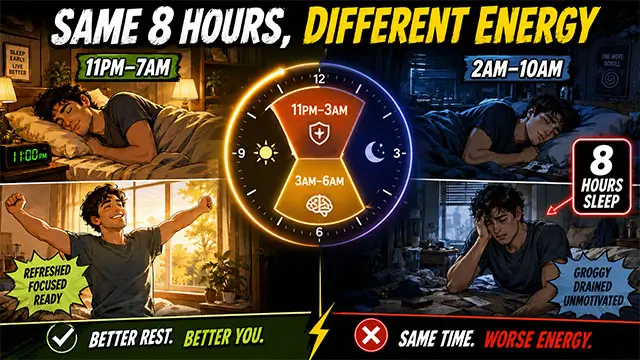
This is why someone who sleeps from 11 PM to 7 AM often wakes up refreshed and focused, while someone who sleeps from 2 AM to 10 AM may feel sluggish and distracted all day — even though both get 8 hours of sleep. Just like a netizen said on X, it doesn't matter how much he sleeps or rests; he still wakes up exhausted.
The difference isn't sleeping duration; it's alignment with your body's natural recovery schedule. So, it is necessary to understand the key stages of recovery for your health.
Two Critical Sleep Recovery Phases Your Body Relies On
Research and clinical observations consistently identify two non-negotiable recovery phases that occur during specific nighttime hours. Each serves a unique and irreplaceable purpose for your physical and mental health.
11 PM – 3 AM: The Physical Repair Phase
This is your body's deep recovery phase, dominated by slow-wave sleep and peak growth hormone release. It's when the bulk of your physical restoration happens.
Key processes during this phase:
Muscle and tissue repair: Your body rebuilds micro-tears from exercise, supports tissue regeneration, and balances inflammation levels.
Growth hormone secretion: Critical for cell renewal, fat metabolism, and muscle mass maintenance, production peaks during the first half of the night.
Immune system strengthening: Your body produces cytokines and immune cells that fight infection and reduce systemic inflammation.
Metabolic regulation: Insulin sensitivity and blood sugar balance are calibrated during early-night deep sleep.
So, if you often miss this recovery phase, it is likely to result in slower recovery from exercise, weakened immune function, increased hunger hormones, and a higher risk of metabolic disruptions over time.
3 AM – 6 AM: The Cognitive Processing & Memory Consolidation Phase
As the night progresses, your sleep shifts toward more REM sleep and lighter cycles, and your brain goes into high gear for cognitive restoration. This phase is when learning, memory, and emotional health get their most important recovery.
Key processes during this phase:
- Memory consolidation: Your brain sorts through the day's information, moves short-term memories into long-term storage, and strengthens what you learned.
Cognitive cleaning: The glymphatic system clears metabolic waste and toxic proteins from the brain, a process critical for long-term brain health and daily mental clarity.
Emotional regulation: Your brain processes and integrates emotional experiences, which is why poor late-night sleep often leads to irritability, anxiety, and mood swings the next day.
Creative problem-solving: REM sleep supports insight and pattern recognition, which is why a full night's rest often helps you solve problems you struggled with the day before.
So, regularly missing this recovery phase can directly impact your next day's focus, decision-making, and emotional stability.
4 Science-Backed Steps to Align Your Sleep with the Recovery Phases
You don't need a perfect schedule overnight. Small, consistent adjustments are far more effective and far more sustainable than drastic changes. Here's what is recommended.
1. Anchor your wake-up time
Your circadian rhythm is set by your wake time, not your bedtime. Pick a fixed wake-up time, including weekends, and stick to it within 60 minutes of that time. This is the single most effective way to shift your entire sleep schedule earlier and align with recovery phases.
Detailed Action: If you're currently waking at 9 AM and want to shift to 7 AM, don't jump two hours at once. Move your wake time 15 minutes earlier every 2–3 days until you reach your target.
2. Get 10–15 minutes of morning sunlight within 1 hour of waking
Morning light is your body's strongest circadian cue. It suppresses melatonin, boosts alertness, and calibrates your internal clock so you'll feel sleepy earlier that night.
Detailed Action: On cloudy days, bright indoor light can work, but natural sunlight is 50–100 times more powerful. This has been shared in a post on X: sunlight, as well as a reason to get up in the morning, can combat depression.
3. Avoid heavy meals and alcohol 3 hours before bed
Late-night heavy meals force your digestive system to work overtime, disrupting deep sleep and reducing the efficiency of physical repair. Alcohol is even more deceptive. While it may make you drowsy, it severely suppresses REM sleep and fragments your sleep cycles.
Detailed Action: Don't have a big meal or drink alcohol for two to three hours before bedtime. If you do feel hungry when you are ready to sleep, have a healthy snack.
4. Gradually shift your bedtime, don't force it
If you’re used to falling asleep at 1 AM, lying in bed at 10 PM will cause frustration and insomnia.
Detailed Action:
- Keep your fixed wake time
- Let your bedtime naturally drift earlier as your circadian rhythm adjusts
- Dim lights and put away screens 1 hour before your target bedtime
- Add a 5-minute wind-down routine (reading, stretching, deep breathing) to signal to your brain that sleep is coming
Final Thought
Having good sleep and being in a good state the next morning is not determined solely by how much sleep you get. It also has much to do with when you fall asleep. If you want a refreshing morning, you should not miss the two key recovery phases; try the adjustment methods that suit you.
FAQ
I'm a natural night owl; do I still need to sleep at these exact times?
If you're a true delayed sleeper, your personal recovery windows may shift slightly later. But you can also experiment with 30-minute shifts and notice how you feel.
Can I make up for the missed recovery phases on the weekend?
You can reduce sleep debt, but you can't "Bank" or "catch up" on the specific repair functions of each recovery phase.
What if I work night shifts?
The best strategy is to create a consistent, dark, quiet sleep environment during the day and keep your schedule identical on days off.
Disclaimer
The content provided in this article and on this website is for general informational and educational purposes only. It is not intended as medical advice, diagnosis, or treatment, and should not be relied upon as a substitute for professional medical guidance from a qualified healthcare provider.

Hi, I'm Chelsea Parker, a globetrotter, storyteller, and life enthusiast with a knack for turning everyday experiences into unforgettable lessons. From surviving $20-a-day adventures in Southeast Asia to mastering mindfulness in my daily routine, I share relatable and entertaining tales that inspire you all to explore, grow, and thrive. When i'm not writing, you may find me chasing sunsets, savoring street food, or dreaming up my next big adventure.

You May Like