Elon Musk’s Bold R500 Million Offer to Connect 2.4 Million learners—But There’s a Catch
For many South Africans, getting online is as simple as connecting to home Wi-Fi.
But for families living in remote communities, reliable internet can still be out of reach.
Now, Starlink says it's ready to invest R500 million (about US$28 million) in South Africa, including a proposal to connect 5,000 rural schools with free high-speed internet—a move that supporters say could benefit more than 2.4 million learners every year.
The proposal has reignited debate online, but beyond the policy discussion, many families are asking a much simpler question:
Could this finally make getting online easier?
Starlink's Proposal at a Glance
According to details widely shared on X, Starlink's proposal includes:
- R500 million investment directly into rural infrastructure.
- 5,000 rural schools connected at zero cost.
- Free high-speed internet for these schools so they aren't burdened with monthly data bills.
- More than 2.4 million learners potentially benefiting each year.
For students, this means instant access to online lessons, digital libraries, and remote tutoring that many urban schools already take for granted.
Why This Matters: Moving Beyond Just "Watching Videos"
When people talk about internet connectivity, it is easy to think about social media and entertainment. But for communities without reliable access, the impact is much bigger.
Unlike traditional broadband, which relies on burying expensive fiber-optic cables or building physical towers in difficult terrain, satellite internet bypasses the ground entirely. Using a network of low Earth orbit (LEO) satellites, a small dish pointed at the sky can pull down fast internet in minutes.
For households in remote farming communities, mountainous regions, and small villages, this type of connectivity changes everything by unlocking:
- Better Education: Access to online courses, exam prep, and global platforms.
- Job & Income Opportunities: Applying for remote work, learning digital skills, and reaching online marketplaces without needing to move to a major city.
- Essential Services: Accessing online banking, government portals, and telehealth consultations.
"The Catch": Why Elon Musk's Plan is Stalled
If the benefits are so clear, why hasn't the South African government immediately signed off?
It comes down to South Africa's telecommunications licensing laws. Under existing regulations enforced by ICASA (Independent Communications Authority of South Africa), any telecom provider must have 30% Black economic empowerment (B-BBEE) ownership to operate legally.
SpaceX, Starlink's parent company, historically insists on maintaining 100% ownership of its subsidiaries globally. While the government has debated creating policy workarounds—like "equity equivalent" investment programs—the political debate remains highly tense, leaving millions of rural families waiting in a regulatory limbo.
Plot Twist: Amazon Moves in to Fill the Void
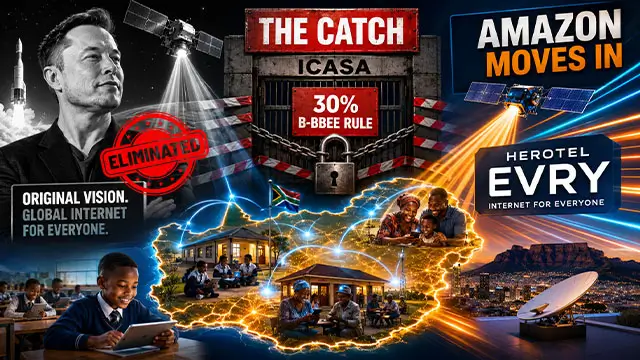
While Starlink is locked in regulatory battles, a massive competitor is quietly preparing to swoop in and take the market.
Amazon (via its Project Kuiper satellite network, now officially branded as Amazon Leo) has partnered with Herotel, South Africa’s largest fixed internet provider, to launch a brand-new satellite service called Evry.
Because Herotel is already a fully licensed, locally compliant South African company, they completely sidestep the regulatory hurdles that have kept Starlink grounded.
Using Herotel's massive footprint of 120 local offices, Evry is on track to commercially launch in 2027, offering high-speed satellite internet to households, farms, and small businesses in the very same underserved areas Starlink has been trying to reach.
The Future of Internet Access is Above Us
Whether the ultimate winner of this space race is Starlink or Amazon's Evry, the real victors will be ordinary South Africans.
The success of these projects won't be measured by corporate investment numbers. It will be measured by a student in a deep rural village joining an online class for the first time, a small-scale farmer checking real-time market prices, and a country finally closing its digital divide.
FAQs
How many South African schools could Starlink connect?
Starlink’s reported proposal includes connecting 5,000 rural schools with free high-speed internet.
How many learners could benefit from the Starlink proposal?
The plan could potentially benefit more than 2.4 million learners annually.
Why is satellite internet useful for rural areas?
Satellite internet can reach locations where fiber networks and traditional broadband infrastructure are difficult or expensive to build.
What is Evry satellite internet?
Evry is a new satellite internet service planned for South Africa, offered by Herotel and powered by Leo technology, targeting areas where existing broadband cannot reach.

Hi, I'm Chelsea Parker, a globetrotter, storyteller, and life enthusiast with a knack for turning everyday experiences into unforgettable lessons. From surviving $20-a-day adventures in Southeast Asia to mastering mindfulness in my daily routine, I share relatable and entertaining tales that inspire you all to explore, grow, and thrive. When i'm not writing, you may find me chasing sunsets, savoring street food, or dreaming up my next big adventure.