No Hospital Nearby? How Technology Is Bringing Doctors to Remote Communities
For many people around the world, seeing a doctor is not as simple as booking an appointment.
It may require hours of travel, expensive transportation, and leaving work or family responsibilities behind.
In rural communities, the nearest healthcare facility can be dozens of kilometers away, turning a basic medical check-up into a major challenge.
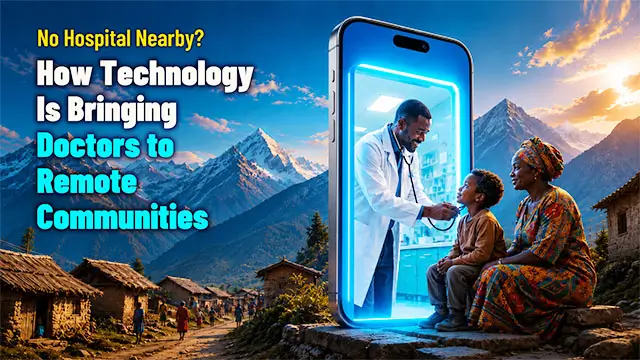
But new technology is changing this reality. In emerging markets, telemedicine is helping doctors reach patients who were previously difficult to serve.
So, what are the barriers behind healthcare in developing countries and how can telemedicine solve the healthcare problem?
🌍The Hidden Barrier to Healthcare: Distance
The World Health Organization estimates that the global shortage of health workers will reach 11 million by 2030, and the gap is widest in the places that need them most.
Across the developing world, the picture is even more striking:
Sub-Saharan Africa carries roughly 25% of the global disease burden but has only 3% of the world’s health workers.
Southeast Asia has vast populations living on islands and in mountainous regions where physical access to healthcare is severely limited.
Latin America has 30% of the population without access to healthcare due to economic reasons, and 21% of the population without access to healthcare due to geographical barriers.
For developing countries, they face these common problems.
1. Doctors are concentrated in cities
One of the biggest challenges facing rural healthcare is that medical professionals are often concentrated in urban areas.
Cities usually have:
- major hospitals
- specialist doctors
- advanced medical equipment
- better healthcare infrastructure.
However, rural and remote communities often have fewer healthcare workers available. According to VestedWorld, rural areas in Sub-Saharan can only boast of about 25% of a country's doctors and nurses on average.
2. Travel costs prevent early treatment
Distance does not only create a transportation problem but also creates a financial barrier.
For many rural families, visiting a healthcare facility involves more than paying for a consultation.
They may also need to consider:
transportation expenses
time away from work
lost daily income
additional costs for family members who accompany them.
As a result, some people delay seeking medical care until their symptoms become more serious.
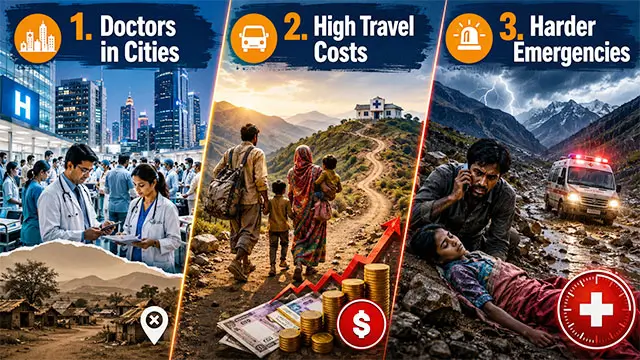
3. Emergency care becomes harder
The distance problem becomes even more serious when patients need urgent medical attention.
In remote communities, emergencies can be complicated by:
limited ambulance availability
poor road conditions
long travel times
fewer nearby healthcare facilities.
When someone experiences serious symptoms, every hour matters.
💻How Telemedicine Actually Works: Mechanisms
To deal with these healthcare problems, telemedicine has come out.
But telemedicine is no longer a novelty. In 2026, it has become "the default entry point for the entire healthcare journey" for millions of people.
Telemedicine isn't just a video call with a doctor. It's a suite of technologies and service models designed to overcome the barriers of distance, time, and infrastructure. It can be divided into three major types.
Mode 1: Real-Time Video Consultations (Synchronous Telemedicine)
This is the most familiar form of telemedicine.
A patient and a doctor connect via video call, similar to Zoom or WhatsApp, but on a secure, HIPAA-compliant or locally regulated platform. The doctor can see the patient, ask questions, observe symptoms, and provide real-time medical advice.
So, patients don't need to travel for hours on unpaved roads and sit in front of a tablet and consult with a specialist far away.
Case 1: Zimbabwe's Telehealth Centers
By 2026, Zimbabwe had established 28 telehealth centers across seven of Zimbabwe's 10 provinces and conducted more than 28,000 virtual consultations, including about 25,000 diagnostic tests.
Mode 2: Store-and-Forward (Asynchronous Telemedicine)
Not every consultation requires a live conversation. In "store-and-forward" telemedicine, clinical information, such as images, lab results, or patient histories, is collected, stored, and transmitted to a specialist for review at a later time.
The specialist reviews the data and provides a diagnosis or recommendation, often within hours.
Teledermatology platforms using store-and-forward technology have demonstrated 40% faster diagnosis times and 60% cost reduction compared to traditional referral processes.
For a patient in a remote village, this means receiving a specialist's opinion in days rather than weeks and without the cost of traveling to a city hospital.
Case 2: India's Aravind Eye Care System
By using the store-and-forward technology, Aravind has developed a software called EYESTALK. With the help of this software a general ophthalmologist can send all the clinical data pertaining to a patient to specialty department such as Retina, Glaucoma along with the images.
Mode 3: Remote Patient Monitoring (RPM)
For patients with chronic conditions, including diabetes, hypertension, and heart disease, telemedicine isn't just about occasional consultations. It's about continuous care. Remote patient monitoring uses portable devices to track vital signs (blood pressure, blood glucose, heart rate) and transmit the data to healthcare providers for ongoing review.
Case 3: Rwanda and Uganda's Chronic Disease Healthcare System
In Rwanda and Uganda, an EU-funded project enables patients with chronic diseases to regularly measure their blood pressure or blood glucose at home and transmit the results via mobile phone to healthcare providers. Clinicians can remotely review these data, identify patients requiring additional support, and provide follow-up care through a telemedicine platform co-designed specifically for rural settings.
What about the telemedicine achievements?
- In Kenya's Murang'a County, a digital healthcare access program using satellite internet has connected all 170 public health facilities, improving healthcare access for approximately 1.2 million residents.
- In Croatia, a network of 33 mobile primary care clinics has been introduced to improve access to health services in rural and remote areas and on the islands.
- In Latin America, telemedicine service accounted for 63.8% of the Latin America telemedicine market in 2025 and is on the rise due to the increasing demand.
- By April 2025, India's platform had delivered more than 360 million teleconsultations, supported by over 232,000 registered healthcare providers through a hub-and-spoke care network.
🧱Why Telemedicine Alone Isn't Enough: Barriers
Technology is powerful. But it's not magic. Several barriers stand between innovation and impact.
Infrastructure
None of this works without electricity and internet.
However, even in 2026, vast areas of Africa, South Asia, and Latin America lack reliable power and connectivity. Low-earth orbit satellite internet (like Starlink) is beginning to fill the gap, but it remains expensive and isn't yet universally available.
The challenge is that scaling these solutions requires investment and many governments simply don't have the budget.
Cost
Technology costs money. The question is: who foots the bill?
For patients: Even low-cost telemedicine consultations may be unaffordable for families living on a few dollars a day.
For governments: Public health systems in developing countries are chronically underfunded. Competing priorities like education, infrastructure, and security, often take precedence over digital health.
For the private sector: Investors are interested in profitable markets. Remote communities with low purchasing power are not always high on their list.
Trust
Technology is only useful if people use it.
In many communities, traditional healers are more trusted than "doctors in a screen". Older patients, in particular, may be skeptical of remote diagnosis.
A 2026 study found that telemedicine uptake has not shown a substantial increase in mental health treatment for patients in rural and low-access areas. Specialists who used telemedicine the most saw only a tiny increase, less than one percentage point, in patients from rural regions.
This suggests that simply offering virtual care isn't enough; active outreach and community engagement are essential.
Regulation
Cross-border telemedicine is complicated by licensing laws. For example, medical data privacy, especially across borders, adds another layer of complexity.
Moreover, regulatory frameworks in many non-Western countries lag behind technological capacities.
As telemedicine becomes more common, governments are beginning to update their laws. But progress is slow.
Conclusion
Telemedicine is not a magic wand. It won't replace the doctor who isn't there, at least not yet. But it can extend the reach of the doctors who are.
Telemedicine doesn't guarantee everyone will have a doctor in their pocket but it can reduce the number of those who die because the nearest hospital is too far away.
To offer better healthcare services, only relying on technology is not enough. Infrastructure, investment, promotion, and regulation also matter.
Have you ever used telemedicine?
FAQ
How does telemedicine work without reliable internet?
Many platforms now offer offline-capable modes or use SMS-based interfaces for basic consultations.
Is AI diagnosis accurate enough to trust?
In specific areas like radiology and dermatology, AI has shown accuracy comparable to or exceeding human doctors.
Is remote healthcare available in my country?
Many countries in Africa, Southeast Asia, and Latin America now have active telemedicine programs, but coverage is often limited to pilot areas or specific partnerships.
Disclaimer
This article is for informational purposes only and does not constitute medical advice. Always consult a qualified healthcare professional for medical decisions. The technologies, programs, and statistics mentioned are based on publicly available information as of July 2026 and may not be available in all regions.

Hi, I'm Chelsea Parker, a globetrotter, storyteller, and life enthusiast with a knack for turning everyday experiences into unforgettable lessons. From surviving $20-a-day adventures in Southeast Asia to mastering mindfulness in my daily routine, I share relatable and entertaining tales that inspire you all to explore, grow, and thrive. When i'm not writing, you may find me chasing sunsets, savoring street food, or dreaming up my next big adventure.