I Took $10 to 6 Countries – Here's What Surprised Me Most About 2026 Food Prices
A $10 bill looks the same everywhere. But what it can buy depends completely on where you spend it. In 2026, rising food prices have changed how families shop, cook, and plan their budgets.
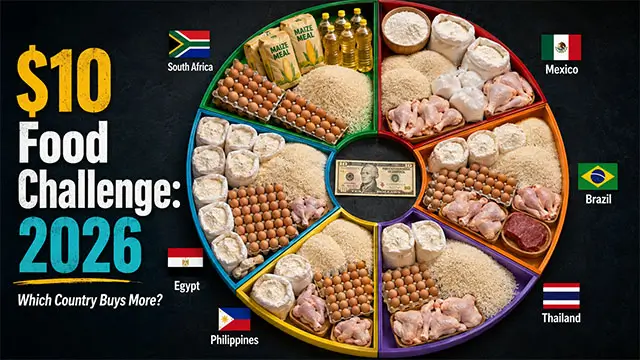
We compared what $10 can buy in six countries — South Africa, Mexico, Brazil, Thailand, the Philippines, and Egypt — to see how different food costs really are.
The results reveal not only price differences, but also how households are adapting to a more expensive food environment.
🌎 What Can $10 Buy in 2026?
🇿🇦 South Africa – 162 Rand
At the current exchange rate, $10 gives you about 162 South African rand, and you can buy:
About 7 kg of rice
About 4.5kg of cooking oil
About 51 eggs
About 10 kg of maize meal
South Africa's food in the basket has increased by 5% or more in June 2026. According to the latest July 2026 Household Affordability Index, a standard family food basket has climbed to 5,530 rand. But over the past five years, cumulative food inflation is close to 30%, so while the monthly increase is small now, the long‑term squeeze is real. Many families have already switched from beef to chicken, and from name‑brand to house‑brand goods.
🇲🇽 Mexico – 171 Pesos
$10 equals roughly 171 Mexican pesos. In Mexico City, you can buy:
8.5 kg of flour
6 kg of rice
5.5 kg of sugar
3 kg of chicken meat
However, the basic food basket rose about 6.3% in May 2026, well above the headline inflation rate of 3.9%. That means food is rising faster than everything else. A family that spent 1,000 pesos on groceries last year now needs 1,063 pesos for the same items — and the gap keeps widening.
🇧🇷 Brazil – 51 Reais
$10 is close to 51 Brazilian reaies. With that money, you can buy:
9.5 kg of flour
8 kg of rice
4 dozen of eggs
5.5 kg of chicken meat
Less than 1 kg of beef meat.
According to a survey, the average value of the basic basket in Brazilian capitals reached R$ 779.95 in June 2026, an increase of 8.69% in 12 months, and began to consume 52.02% of the worker's net minimum wage. Such food inflation will drive many people to abandon other pleasure to make sure their
🇹🇭 Thailand – 330 Baht
$10 gives you about 330 Thai baht — and that goes surprisingly far, especially if you eat like a local. At Thailand, you use 330 baht to buy:
5.5 kg of flour
9 kg of rice
4 dozen of eggs
3 kg of chicken meat
Thailand food inflation has cooled in the first quarter of 2026. However, according to the statistics of Bureau of Trade and Economic Indices, Ministry of Commerce, cost of food in Thailand increased 2.04% in July 2026 over the same month in the previous year.
🇵🇭 Philippines – 608 Pesos
$10 is about 608 Philippine pesos. And here, the pressure is more intense, because you can only buy:
5.5 kg of four
6.5 kg of rice
4.5 dozen of eggs
Less than 3 kg of chicken meat
This year, $10 can buy 6.5 kg of rice; however, you can use the same budget to buy 10.5 kg. That 4‑kg loss may not sound like much, but for a minimum‑wage earner, it's real. Many Filipino families are stretching rice with root crops like cassava, or buying in bulk from community rice cooperatives to save a few pesos per kilo.
🇪🇬 Egypt – 500 Pounds
$10 equals about 500 Egyptian pounds (EGP). Egypt has the highest inflation among the six, but that doesn't mean you will buy least food. You can use the $10 to buy:
12.5 kg of flour
11 kg of rice
7 dozen of eggs
2 kg of chicken meat
However, food prices in June 2026 were 3% higher than June 2025. Among this, beef and veal prices are predicted to increase 10.7% in 2026 and egg prices are predicted to increase 30.7% in 2026. To deal with so shocking food inflation, families are replacing wheat flour with maize flour, and cooking with less oil to make every liter last longer.

📈 Why Is Food Getting More Expensive Everywhere?
It seems that food inflation takes place around the world. So, have you thought about the reasons why food getting more expensive everywhere?
🌾 Higher Costs from Farming and Production
One of the biggest reasons behind rising food prices is the increasing cost of producing food. Farmers rely on many resources to grow crops and raise animals, including:
fertilizer
fuel
electricity
equipment
labor.
When these costs increase, farmers often have to charge more to maintain their operations. By the time products reach supermarkets or local markets, consumers may end up paying significantly more than before.
🌦️ Extreme Weather Is Affecting Food Supply
Nowadays, extreme weather has taken place more frequently, which also affects food production. Extreme events such as:
droughts
floods
heat waves
storms
can damage crops, reduce harvests, and affect livestock production.
When supply decreases while demand remains high, prices often rise.
🚢 Transportation and Supply Chains Add Hidden Costs
Many consumers only see the final price on a shelf, but food often travels through a long journey before reaching them.
Farm → Processing → Storage → Transportation → Retail Store → Consumer
Every step adds costs.
Imported foods can be especially affected because they depend on international shipping and currency exchange rates.
🛒 How Families Can Save Money When Food Prices Rise
While we cannot control global food prices, we can make small changes that help their grocery budgets go further.
🥦 1. Buy Seasonal and Local Foods
One of the easiest ways to save money is choosing foods that are in season and locally available.
When a product is in season, there is usually a larger supply available, which can help keep prices lower. Local foods can also cost less because they often require:
shorter transportation distances
fewer storage costs
less dependence on imports.
📋 2. Plan Meals Before Shopping
Many families spend more on food not because prices are high, but because they buy more than they need.
Planning meals before going shopping can help avoid:
impulse purchases
unnecessary items
food waste.
So, before shopping, you can:
check what food you already have at home
create a shopping list
decide which meals to prepare.
🍳 3. Choose Alternatives Without Sacrificing Nutrition
When certain foods become more expensive, replacing them with affordable alternatives can help maintain a balanced diet while reducing costs.
For example, instead of relying heavily on expensive sources of protein, families can consider alternatives such as:
eggs
beans
lentils
local protein sources.
Affordable ingredients can still provide important nutrients when combined properly.
Conclusion
Food prices are changing around the world, and the same $10 can have very different purchasing power depending on where you live.
While global factors like production costs, weather, and supply chains affect prices, small daily choices can help families manage their food budgets.
Understanding where your money goes is the first step toward making smarter spending decisions.
FAQ
Does $10 buy the same amount of food in every country?
No. The value of $10 depends on local food prices, wages, currency exchange rates, and the cost of living in each country.
Does a lower food price always mean a lower cost of living?
Not necessarily. A country may have cheaper food prices, but households may still face financial pressure if average incomes are lower or if food takes up a larger share of monthly expenses.
Why do exchange rates affect how much $10 can buy?
Exchange rates determine how much one currency is worth compared with another.
Disclaimer
The food prices and examples mentioned in this article are for informational purposes only and may vary depending on location, store, season, and market conditions. Currency conversions are approximate and based on exchange rates that may change over time. Actual purchasing power can differ between cities and households depending on income levels and local costs.

Hi! I'm Aria — someone who loves sharing everyday randomness and has an obsession with AI.I like writing about funny little things in life — weird stuff I run into while traveling, or the cool (and not-so-cool) things I've discovered while messing around with AI tools. I'm all about finding the fun in the ordinary. Stick around for the stories I've picked up along the way, and feel free to share your own too!